
As the warmer months arrive and many of us spend more time outdoors, I want to take a moment to address a public health concern that I see with regularity in my practice: tick-borne illness. Lyme disease and its co-infections are not merely a nuisance of the woods. They can produce a wide and often misunderstood spectrum of neuropsychiatric, immunologic, and systemic manifestations—frequently long after the initial bite, and frequently without the classic rash or flu-like prodrome to announce themselves. As I have long maintained, the most reliable treatment for these conditions is to never acquire them in the first place. Prevention, in this domain, is genuinely worth far more than a pound of cure.
Here in New Jersey and throughout the Northeast, the deer tick (Ixodes scapularis) has become so widespread that complete avoidance of tick habitat is, for most of us, impractical. We are not willing to surrender our gardens, our hikes, our children’s playing fields, or our time outdoors. The reasonable goal, then, is not avoidance but informed protection. I want to highlight one of the most effective and underused tools available to you: permethrin-treated clothing.
What permethrin is, and what it does
Permethrin is a synthetic compound modeled on a natural extract of the chrysanthemum flower. It is not a skin repellent—it is applied to fabric, not to your body. When a tick contacts permethrin-treated clothing, the compound acts on the tick’s nervous system, rapidly incapacitating or killing it. Research from the CDC has shown that even brief contact with treated fabric—on the order of seconds to a minute or two—causes ticks to become disabled or to fall off. In effect, your clothing becomes an active barrier rather than a passive one.
How to use it
You have two equally valid options:
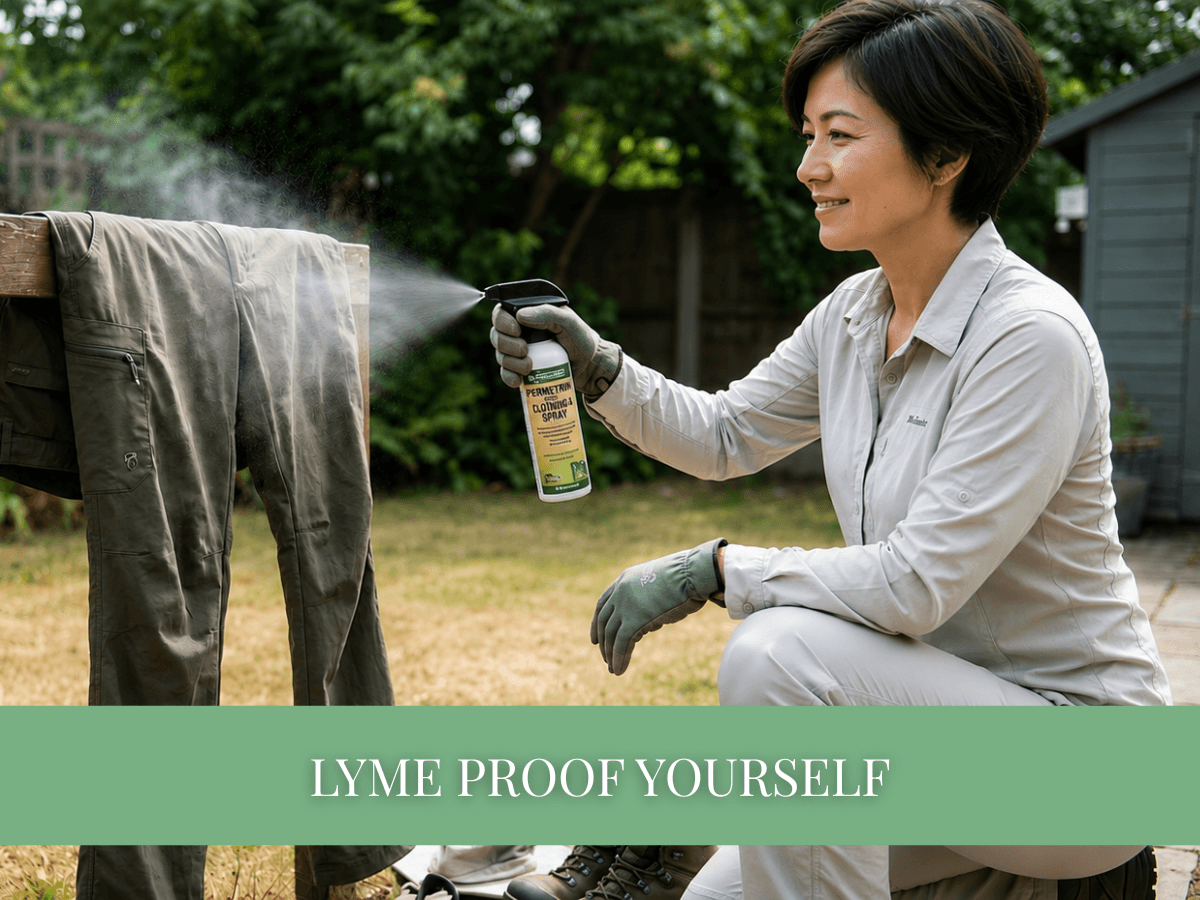
- Treat your own clothing. EPA-registered permethrin sprays are sold under brand names such as Sawyer, Repel, and others, and are widely available at outdoor retailers and online. The standard recommendation is a 5% permethrin product applied to the outside of clothing, shoes, socks, and gear. Apply it outdoors in a well-ventilated area, and allow the garments to dry fully—ideally 24 to 48 hours before wearing—before dressing. A single home treatment typically remains protective through roughly six washings. Wash treated clothing separately from untreated items.
- Purchase pre-treated clothing. Factory-treated garments (marketed under names such as Insect Shield) retain their protection considerably longer—often through the lifespan of the garment—and remove the guesswork of self-application.
A few important safety points
- Apply permethrin to clothing only—never directly to skin. Humans metabolize it quickly, and treated clothing has been evaluated extensively and found safe, including for children, and for pregnant and nursing women, when used as directed.
- Do not inhale the spray. Treat garments outdoors and let them dry before handling.
- Permethrin is highly toxic to cats while it is wet. Keep cats away from freshly treated, undrying clothing. (It is safe once fully dried, and is safe for dogs.)
- Store concentrate safely and away from children.
Permethrin is one layer—not the whole strategy
I want to be clear that permethrin-treated clothing is most effective as part of a broader approach, not as a substitute for the rest:
- Use an EPA-registered skin repellent (DEET, picaridin, IR3535, or oil of lemon eucalyptus) on exposed skin.
- When possible, walk in the center of trails and avoid high grass, brush, and leaf litter.
- After being outdoors, shower and check your body, your children, and your pets for ticks. Prompt removal markedly reduces the chance of disease transmission.
- Tumble-dry clothing on high heat for at least 10 minutes when you come indoors to kill any ticks hitching a ride on dry fabric.
- Remember that pets can carry ticks indoors; check them and consider veterinary tick prevention.
Tick-borne illness is, in my clinical experience, both more common and more consequential than most people appreciate—and far easier to prevent than to treat. The measures above are simple, inexpensive, and well supported. I encourage you to adopt them this season.
If you have questions about tick-borne illness, its long-term neuropsychiatric implications, or your own risk, please do not hesitate to raise them with me.