
Part 1 of 8 in the Psychoecology series by Dr. Katherine Morris
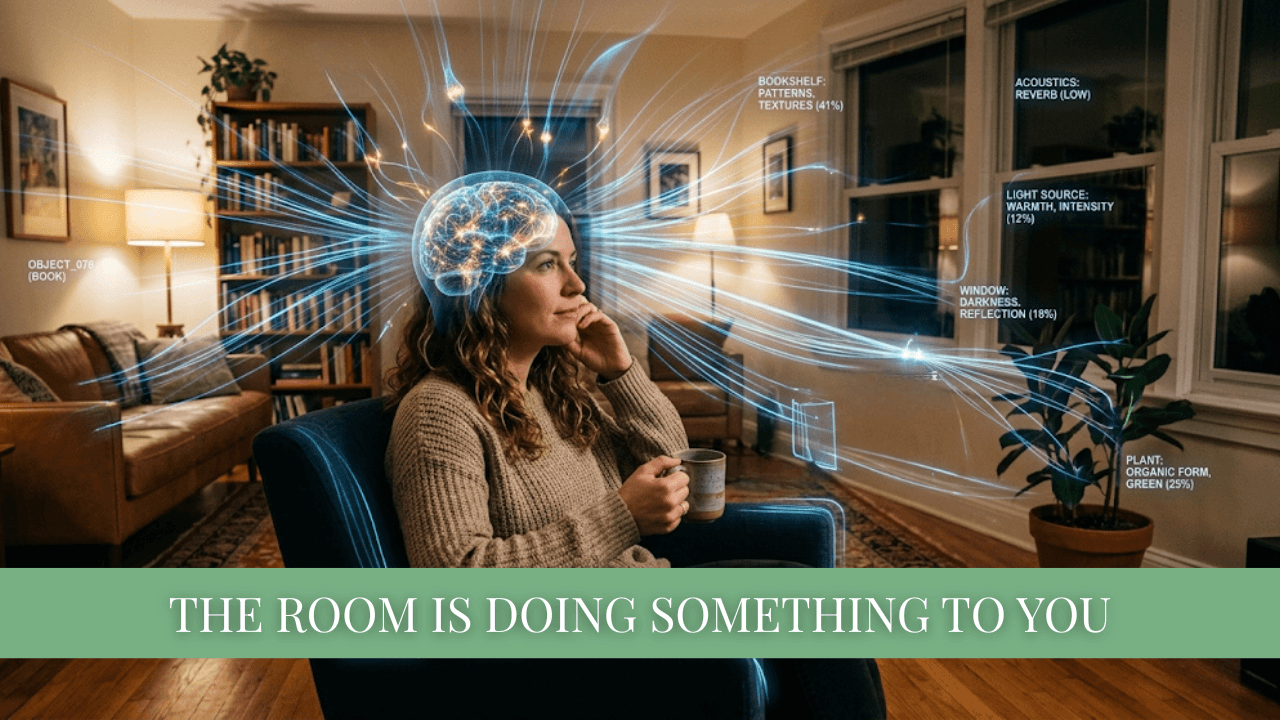
Your brain never stops processing the room you are in. Not when you are focused on something else, not when you are asleep, not when you think you have tuned it out. The hippocampus, that seahorse-shaped structure running your spatial navigation and your autobiographical memory out of the same neural tissue, is firing place cells right now, mapping where you are with the same circuitry it uses to organize who you have been. The amygdala has already assessed the proportions of your ceiling, the visibility of the exit, the quality of the light, and issued its preliminary threat report, all before you finished reading this sentence. You were not consulted. You never are.
This is the foundational fact of Psychoecology: the built environment is not a backdrop to human experience. It is one of its active ingredients — continuously, measurably, and largely without our awareness shaping how we feel, how we think, how we relate to other people, and whether we are capable, at the end of a day, of recognizing ourselves.
The fluorescent hum of a waiting room is not ambiance. It is a stressor, measurable in cortisol. The open-plan office with no wall at your back is not a design philosophy. It is an architecture of persistent low-grade threat. The narrow corridor, the sealed air, the windowless conference room are not neutral choices. They are biological events with biological consequences.
What Psychoecology Is
Psychoecology is the field that takes this seriously. Not as an observation, not as a preference, but as the basis for a rigorous practice — one that draws on environmental neuroscience, Jungian depth psychology, the Internal Family Systems model, the accumulated spatial wisdom of feng shui, and the structural phenomenology of Christopher Alexander, and synthesizes them into a unified account of how space shapes selfhood and what to do about it.
What distinguishes Psychoecology from adjacent fields is not its subject matter but its insistence on integration. Architecture has the buildings but not the psychology. Psychology has the inner life but rarely the room. Environmental neuroscience has the mechanisms but not the meaning. Feng shui has the practice but has been denied the vocabulary that would make it legible to a Western academy. Psychoecology holds all of it at once — because the person in the room is, simultaneously, all of it at once.
A space is never only a neurological event, or only a symbolic one, or only a relational field. It is all three, simultaneously. And a practice adequate to that understanding must make decisions at all three levels. That is new. And it is necessary.
Why This Matters for Mental Health
In clinical practice, we spend enormous energy helping people understand their patterns — why they cannot rest, why they cannot sustain attention, why intimacy feels difficult, why something feels persistently wrong without a clear identifiable cause. We look, rightly, at developmental history, attachment patterns, nervous system regulation, the inner world of parts and exiles and protectors.
What we rarely look at is the room.
This is a significant gap. Because the room is not passive. It is actively participating in the production of every symptom we are trying to address. The person who cannot relax at home may be living in a space that the nervous system cannot read as safe. The person who arrives at session depleted, unfocused, and unable to access their own inner life may have spent eight hours in an environment designed with no regard for attentional biology. The person whose relationships feel perpetually managed and surface-level may be living and working in spaces that structurally preclude genuine encounter.
Psychoecology does not replace clinical work. It extends it into the three-dimensional environment where that clinical work, and the life it supports, takes place.